


4-in-1 Electric Muscle Stimulator EMS Interferential High-Frequency Physiotherapy Device Electrostimulator for Muscle Relaxation
4-in-1 Electric Muscle Stimulator EMS Interferential High-Frequency Physiotherapy Device Electrostimulator for Muscle Relaxation
SPECIFICATIONS
Application: BODY
Brand Name: NONE
Certification: CE
Choice: yes
Electronic: No
High-concerned chemical: none
Is Batteries Included: no
Origin: Mainland China
Plug Type: EU Plug
Voltage: <50V AC
Advanced 4-in-1 TENS EMS IF RUSS Device
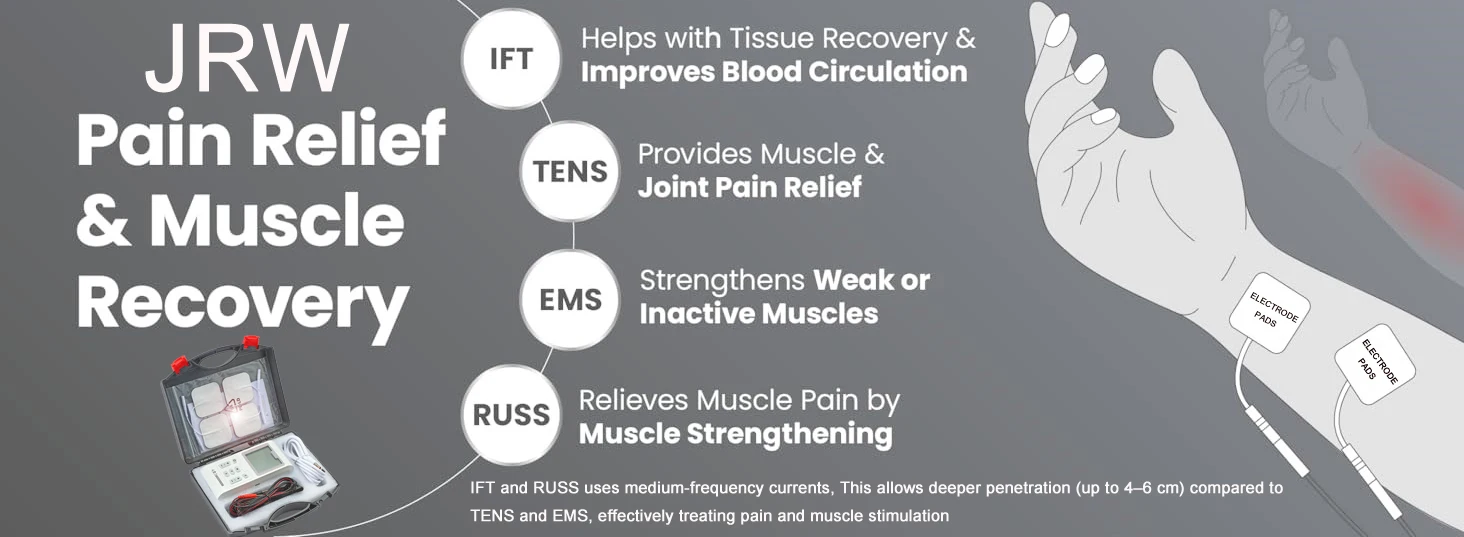
Transcutaneous Electrical Nerve Stimulation (TENS) ~ Low frequency. / Electrical Muscle Stimulation (EMS) ~ Low frequency. / Russian Stimulation (RUSS) ~Medium-high frequency. / Interferential Stimulation (IF) ~ Medium-high frequency.
Product Description
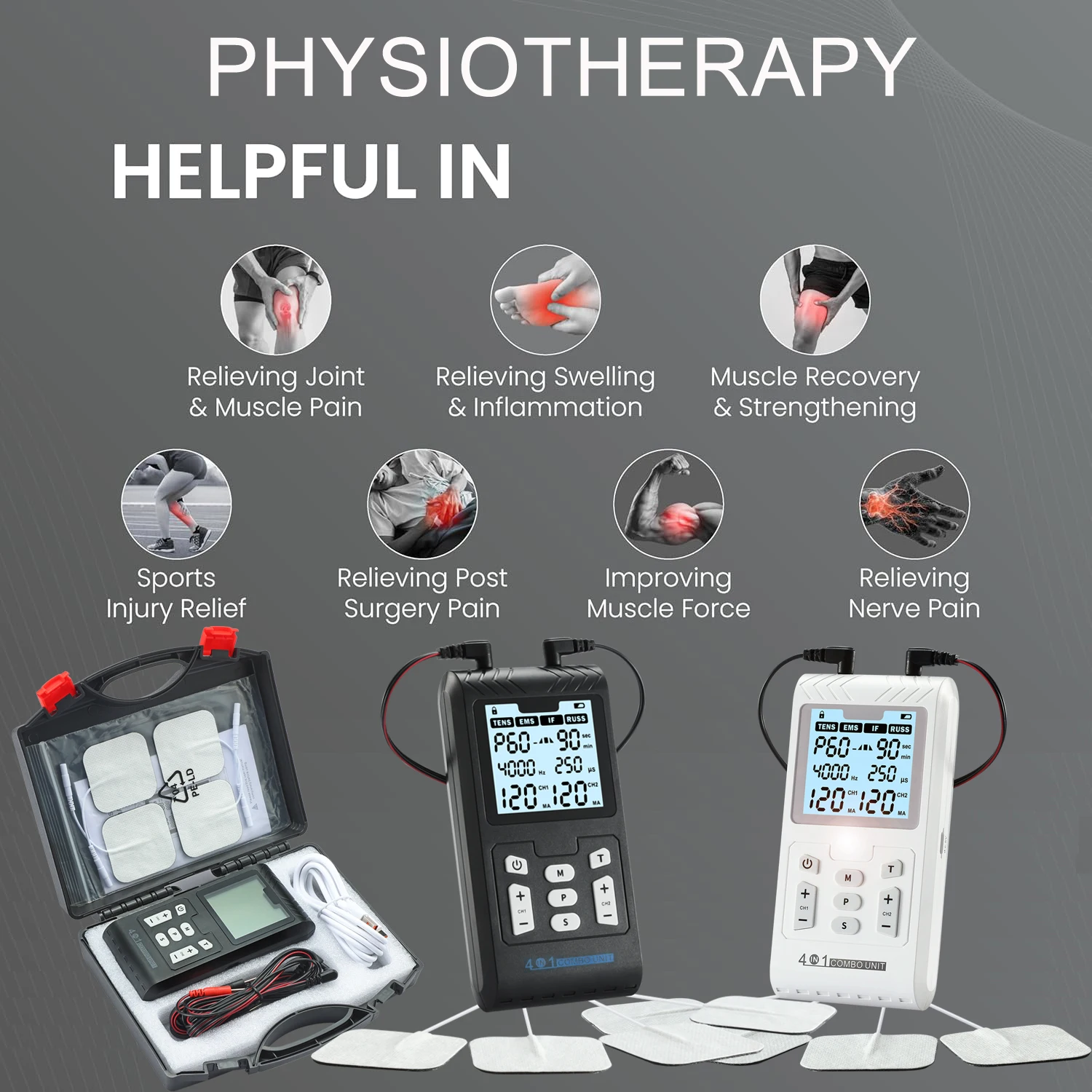
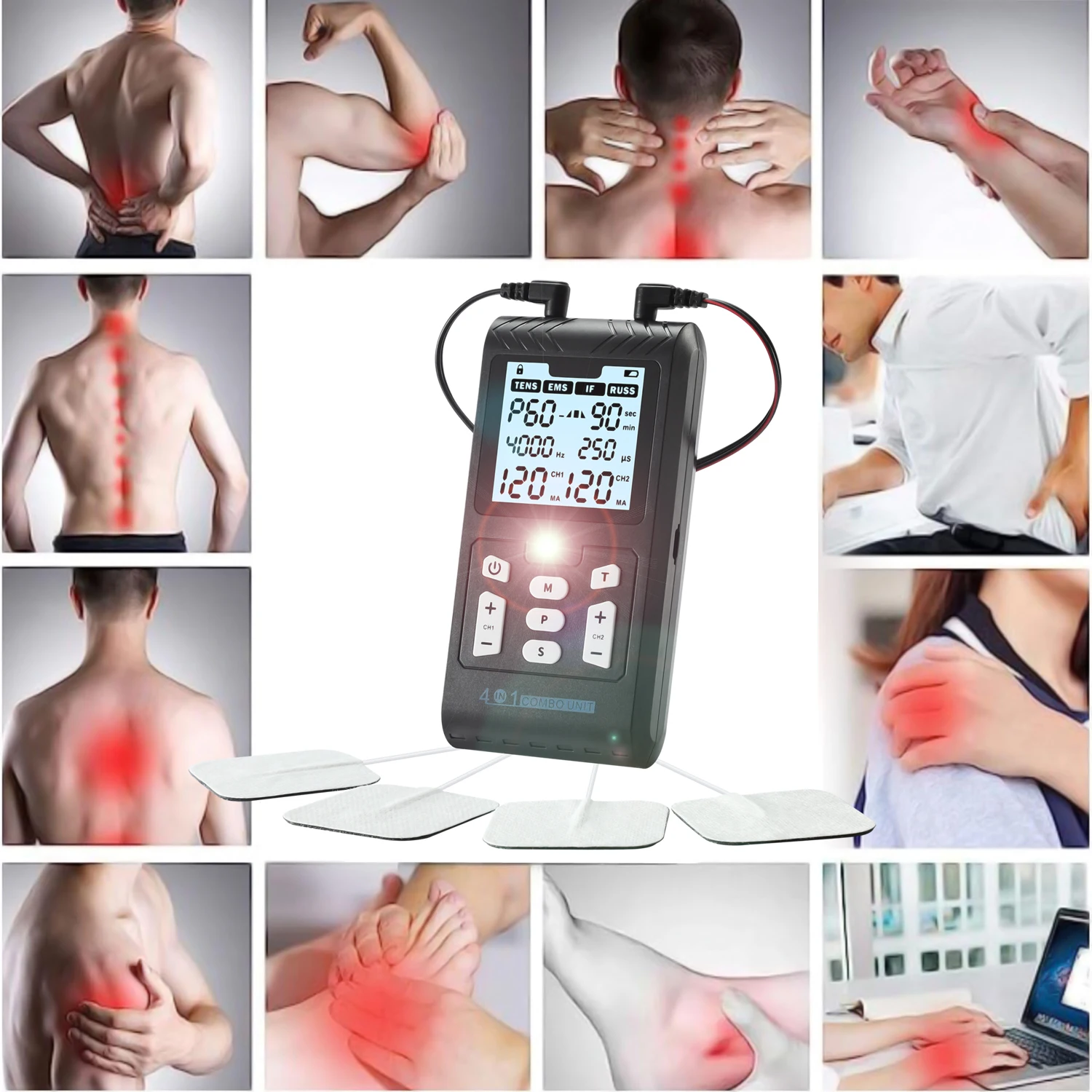
JRW 7300 – Portable IFT Physiotherapy Machine with Advanced TENS & (EMS) Electric Muscle Stimulator and Russian Physiotherapy for For Rehabilitation Center Hospital, Clinic, Gym, Home Physiotherapist. and for effective pain relief, muscle recovery, and relaxation. This 4-in-1 device offers high-frequency therapy to target deep tissue, reduce soreness, and enhance circulation,Doctor Recommend, Deeper Tissue Penetration, Comfort, Larger Treatment Area, Powerful Effective, Medium-High frequency, High Intensities, strong contraction.
Products Feature
1.Total Programs: 60 modes (TENS, EMS, IF, RUSS)
2.Dual Channel Control: Mode and intensity for each channel can be adjusted independently.
3.Customizable Parameters: Users can personalize settings to meet specific therapeutic needs.
4.Intensity Levels: 0–120 steps (Max output: 120mA)
5.Treatment Duration: Adjustable from 5 to 90 minutes (1-minute steps)
6.Clear Display: Frequency and pulse width of each mode are shown on the screen.
7.High tech design with extra-large LCD display – Easy to see & use!
8.Doctor Recommend & Patient Trusted
Adjustable parameters
TENS(Transcutaneous Electrical Nerve Stimulation)
Programs:23 fixed + 2 customizable
Frequency:Adjustable from 1 Hz to 800 Hz (1 Hz/step)
Pulse Width: Adjustable from 50 μs to 300 μs (1 μs/step)
EMS (Electrical Muscle Stimulation)
Programs:13 fixed + 2 customizable
Frequency:Adjustable from 1 Hz to 800 Hz (1 Hz/step)
Pulse Width: Adjustable from 50 μs to 300 μs (1 μs/step)
Ramp Up Time: 1–9 seconds
Contraction Time: 1–60 seconds
Ramp Down Time: 1–9 seconds
Relaxation Time: 1–60 seconds
IF (Interferential Current)
Programs: 8 fixed + 2 customizable
PU1 Mode:
Channel1: 4000 Hz (fixed)
Channel2: 4001–4150 Hz
Interference Frequency: 1–150 Hz
PU2 Mode:
Channel 1: 2500 Hz (fixed)
Channel 2: 2501–2650 Hz
Interference Frequency: 1–150 Hz
Cycle Time: Adjustable from 5–60 seconds
RUSS (Russian Stimulation)
Programs: 8 fixed + 2 customizable
PU1 Mode:
Carrier Frequency: 2500 Hz (fixed)
Adjustable Frequency: 1–100 Hz (1 Hz/step)
PU2 Mode:
Carrier Frequency: 2000 Hz (fixed)
Adjustable Frequency: 1–100 Hz (1 Hz/step)
Cycle Time: Adjustable from 5–60 seconds
Advantages of Russian Stimulation (vs. General EMS)
1.Superior Muscle Force Production:
Its medium-frequency, burst-modulated waveform reduces skin resistance, allowing deeper penetration with less discomfort. This enables the delivery of a stronger, more comfortable current that can produce near-maximal or maximal voluntary contractions. This is its biggest advantage for strength training and rehabilitation.
General EMS: Lower-frequency currents encounter higher skin impedance, causing more superficial stimulation and discomfort at intensities needed for strong contractions, limiting its effectiveness for true strength gains.
2.Optimized for Neuromuscular Re-education:
It is exceptionally effective for "re-teaching" a muscle to contract after injury or surgery (e.g., ACL reconstruction, post-immobilization). The strong, controlled contraction provides potent sensory feedback to the brain, helping rebuild the neural pathways for voluntary movement.
General EMS: While it can prevent atrophy, it's less effective for this high-level retraining because it doesn't typically produce contractions of sufficient force or specificity.
Advantages of Interferential Current (vs. General TENS )
Deeper Tissue Penetration
IF: IF uses two medium-frequency currents (e.g., 4000 Hz and 4100 Hz) that intersect inside the body. Their interference creates a low-frequency beat frequency (e.g., 100 Hz) that can effectively stimulate deeper tissues (muscles, joints, capsules) with greater comfort. This allows deeper penetration (up to 4–6 cm).
TENS: typically using low-frequency currents (e.g., 2-150 Hz), encounters higher skin impedance, making it less efficient at reaching deep structures.
2. Greater Patient Comfort
IF: The medium-frequency carrier waves pass through the skin with less resistance, causing less stimulation of superficial pain receptors (nociceptors). The resulting therapeutic effect is felt deeper, making the surface sensation more comfortable.
TENS: Low-frequency currents can be more irritating to the skin and superficial nerves, often described as a sharper, more prickly sensation, which can be uncomfortable at higher intensities.
3. Versatility in Treatment Goals
IF units typically offer more programmable parameters, allowing them to target both pain management and muscle stimulation effectively.
4.Larger Treatment Area & Better Targeting
The vector effect or frequency sweep of IFC allows the clinician to "scan" a larger area or precisely target the intersection of the currents to a specific deep tissue site.A standard TENS unit with two electrodes treats a more localized, superficial area between the pads.



Product features
Product features
Materials and care
Materials and care
Merchandising tips
Merchandising tips


